Login
Register

 Joanne Taaffe
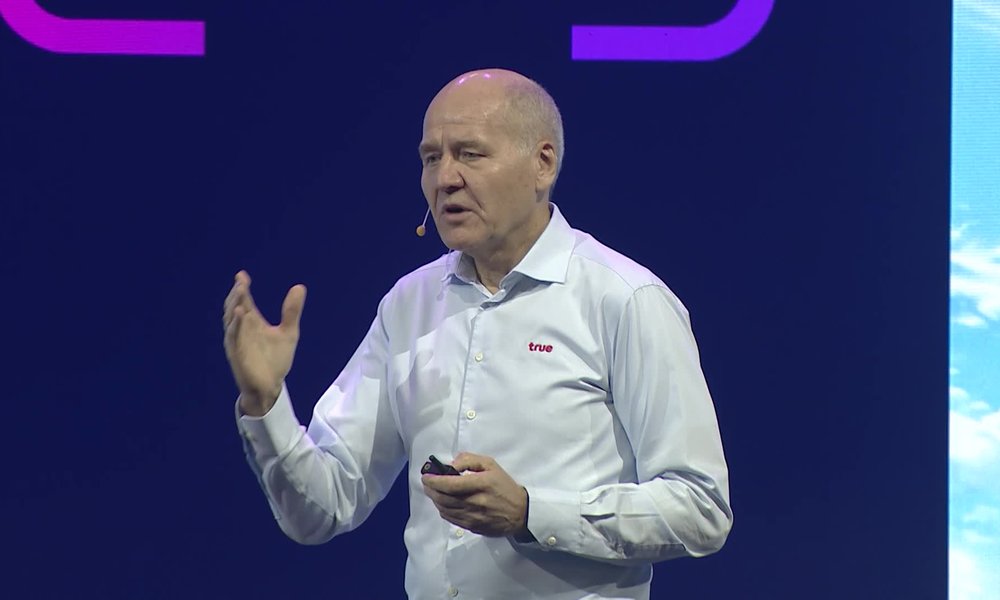
True Corp Group CEO urges telcos to accelerate pace of AI transformation
Sigve Brekke, Group CEO, True Corporation warned that while AI presents a significant opportunity for telcos, it also represents a potential existential threat.
“I’m much more positive on our industry’s future if you’re able to grab this,” he said. “At the same time, I think the risk of being out of business is also much, much bigger.”
Brekke argued that the pace of AI-driven change leaves operators little room for the gradual transformation programmes that have characterised the industry for the past 25 years.
“The race is so different from what it used to be,” he said. “Not all of us will be able to make this.”
However, he argued that many telcos lack urgency when it comes to AI-transformation because their core businesses remain profitable, delivering revenue growth of 3,4 or 5%, strong EBITDA margins, and reliable dividend payments.
True aims to become an AI-native company by 2030, operating 5,000 AI agents, described by Brekke as “AI employees."
The company wants AI to add between two and three percentage points of growth on top of the three to five percentage points it expects from its core connectivity business. In operations, it is targeting efficiency improvements and cost reductions of up to 30%.
Success, he argued, will depend on a total rethink of operations. “AI is about reinventing your entire business” as though it were being created from scratch, he said. “If you have that mindset, you have a chance to win.”
For True, this has meant moving beyond isolated use cases and applying AI across entire business domains, including B2B, B2C, finance and human resources. The company has also simplified its products and substantially reduced the number of business processes before attempting to automate them.
True has already rebuilt its B2B operation into what Brekke called an “AI machine”, applying the technology to sales, customer engagement and joint selling with a partner. After four months, the company recorded a 60% increase in sales opportunities and a 7.1 percentage-point improvement in win rates, he said.
In the consumer market, True is using AI to micro-segment more than 50 million mobile customers and 2.5 million online customers. The approach has reduced churn by 1.2 percentage points while making upselling more effective, according to Brekke.
The operator has also divided Thailand into 6,000 local areas and is providing teams in each area with AI-generated operational and commercial intelligence. This includes information about base-station load and congestion, point-of-sale inventory and local market share, together with recommendations for action.
True has trained half of its employees to use AI and currently has 130 employees working as AI builders. It plans to increase that number tenfold to 1,300 within three years.
Brekke said clear governance and measurable targets are essential to scaling such initiatives. Operators should establish explicit goals for revenue, costs and efficiency, while removing activities that do not contribute to those objectives.
Telcos also have to rethink partnerships, claims Brekke.
“We name ourselves as good at partnership. I think that none of us are,” he said, arguing that the industry have traditionally approached partnerships as transactional sales relationships rather than shared commitments to achieving specific business outcomes.
True has established strategic relationships with Microsoft, AWS and Accenture and expects to announce two more, he said.
Brekke b telcos can use their networks, spectrum licences, security capabilities and regulated local presence to create new AI-related revenues. Opportunities could include monetising trusted security capabilities, selling AI tokens and providing new services to business and small and medium-sized enterprise customers.
The alternative is to be a utility provider while global technology platforms capture much of the value created by AI, he warned.
Brekke said the transformation ultimately requires telecom executives to reconsider their own suitability to lead AI-native businesses. Leaders cannot delegate responsibility for understanding AI to a chief AI officer, CIO or specialist team, he argued. Instead, they must dedicate significant time to understanding the technology and rethink how they would build their companies if they received their operating licences today.
“This is going to be super hard for all of us,” he said. “Those of us that are not able to do this will not be around.”