The AI ROI conundrum: Are we thinking end-to-end?
 Chris Silberberg
The AI ROI conundrum: Are we thinking end-to-end?
A telco is a business first, and a network operator second. Every investment dollar needs to create tangible value or it becomes another cost to strip out later. In 2026 we are starting to see the alarms flash from the telco industry’s investments in AI. On 10th September Bain released its report AI in Telecom: The Opex Reckoning warning that in a scenario where an operator falls into several AI cost traps it could add 20-30% to its operational costs without any corresponding rise in value created.
Scott Petty, Group CTO at Vodafone, highlighted on a panel at DTW Ignite how Vodafone recognized over €100 million net benefits from AI in the 2025/26 financial year. However, he pointed out that “not everything you build with AI has good business value. The cost of running [can be] actually more than the value it delivers. We have literally turned off hundreds of use cases because we couldn’t see the business value relative to the costs that are in place and being able to manage that cost effectively is super important.”
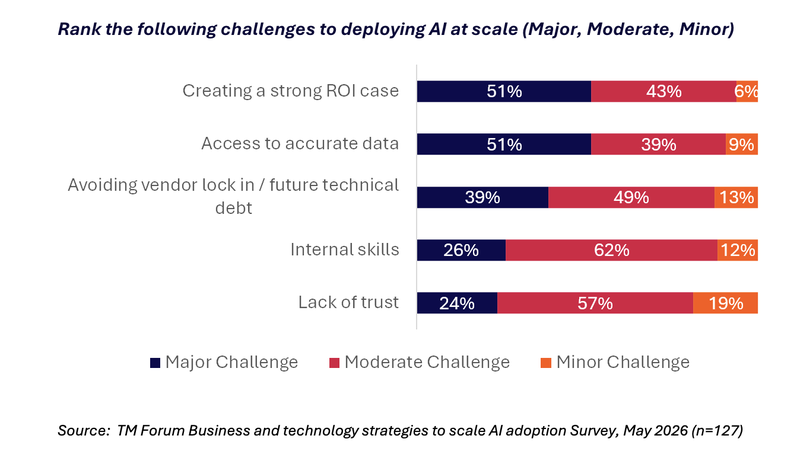
TM Forum’s own research data from May highlights similar themes. Creating a strong ROI case for deploying AI is as challenging as having access to the accurate data that makes an AI deployment viable.
So how do we resolve this tension? Some of the most compelling stories of AI ROI come when a business truly rethinks how and why work gets done, and reframes problems around outcomes. Another example shared at DTW Ignite came from Jussi Tolvanen, CEO, DNA Finland: An initial project to deliver a zero-touch customer experience failed. A second attempt which redesigned business processes to use AI strengths to augment customer agents workflows reduced customer care work by 34%. Tolvanen’s closing message: “Don’t AI crappy processes.”
Yet even when we consider a workflow like order to activation, resolving a customer billing inquiry, or managing a network fault we are at risk of not thinking big enough to truly change the fundamentals of the telco business. In many of these cases AI can be used to increase efficiency, accuracy and speed of response – but does that really change how the business operates?
Since DTW Ignite in June the conversations I’ve had with telcos, vendors, and increasingly within the TM Forum itself point to the need for us to attempt to truly rethink the Telco business model. In particular, how do we use AI capabilities to deliver a truly autonomous business experience: one where systems consume inputs from across the organization, weigh the frameworks they operate within, and decide how best to execute to make the business run better. Two scenarios envision how an autonomous telco could operate.
When the network drives the business
Sunday afternoon. A flood of fault alarms trigger; triage points to a fiber cut on a residential street, and a field team is dispatched to assess the damage and scope a fix. The response doesn't stop at the network layer. The same signals travel in parallel to the customer layer, identifying affected subscribers, issuing timely communications, and automatically crediting accounts for the disruption. This speed of response helps contain customer anxiety and churn before either has a chance to build.
When the business drives the network
Monday morning. A capacity review flags five residential areas with excess mobile capacity. Network planning forecasts excess capacity will persist for at least the next twelve months. That insight triggers a marketing campaign the same week, targeting prospects with attractive fixed-wireless-access deals. Each new subscription flows directly into network configuration — and once new subscribers have absorbed a meaningful share of the spare capacity, the marketing campaign is closed.
AI ROI not confined by traditional silos
AI is a pre-requisite for both scenarios to happen at the speed and efficacy described, with architectural decisions taken that may not make sense if limited to traditional silos. For instance, developing a reasoning layer that includes a framework for understanding end-to-end terminology and data. Developing such a context and reasoning layer is a challenging prospect, but would be crucial if the business was running these scenarios autonomously.
If the area with excess mobile capacity for FWA has only 60 households in it, then the business is not going to spend $1 million dollars advertising to the neighborhood. Conversely when someone subscribes to an FWA deal, the network would need to understand that the usage profile of a family of four with two young children is likely to be radically different from a household with a single young professional.
In theory, each scenario could be cobbled together from tactical AI implementations in multiple workflows, and within domains. My expectation is that such an endeavor is more likely to replicate the barriers of the past, with observed gains being meaningful, but less than differentiating. This does not mean tactical AI investments have no value whatsoever, but it should hopefully prompt some consideration of what are the holistic investments required that cut across multiple use cases. Investments in data access and quality (the second biggest problem in scaling AI) which may not show up next to a reduction in customer churn, increase in spectral efficiency, or reduction in network faults, but act as a catalyst for further AI value creation.
If AI is really as transformative as we’ve all been claiming these last few years, then it is maybe time to be truly transformative in our thinking of how we use it to find those strong ROI cases. Some of those will need to run across the entire business, as after all a telco is a business first, and a network operator second.