Login
Register

 Joanne Taaffe
Telco results show signs of AI service growth
Are communications service providers’ investments in AI starting to translate into higher revenues? Certainly, the latest round of quarterly results show a small but growing number of CSPs accrediting financial growth to their AI strategies.
TELUS, Softbank Corp, and IOH all pointed to how investments in AI services and AI-driven operational efficiency contributed to their bottom line in the quarter ended 31 March 2026.
And although Deutsche Telekom was among the many operators that have yet to detail AI’s impact on its financial performance it intends to do so during a capital markets day to be held 5 October 2026, according to Timotheus Höttges, CEO Deutsche Telekom, speaking during the company’s Q1 2026 earnings call.
“My number one priority in the company is implementing AI and working in AI,” said Höttges.
When it comes to AI service figures, TELUS stands out with its report of 22% revenue growth from AI-enabling capabilities in the first quarter of 2026. Referring to the “momentum of our AI-driven strategy”, the company aims to increase revenue from AI capabilities from $800 million in 2025 to around $2 billion in 2028 across both TELUS Digital and TELUS Business Solutions.
IOH meanwhile, reported a 12% year-on-year increase in revenues for the quarter of 31st March 2026, which, at IDR 15.2 trillion, (US$867 million) were, it said, the highest in its history. Its core mobile services accounted for much of the growth. They delivered a 15% increase in blended ARPU to reach IDR 45,000 (US$2.56), with the company attributing the uplift to its AI hyperpersonalization strategy. Data traffic, meanwhile, grew by 25.1% year-on-year .
One of TELUS’ successes, highlighted in its earnings call, was its Sovereign AI Factory, which it said sold out of compute capacity within months of launch.
Sovereign AI has also been a driver in Indonesia. IOH’s AI compute platform, called AI Neocloud, delivered revenues of $16 million in the first quarter of 2026, compared to $28 million for the whole of 2025. The company now expects AI Neocloud to meet revenue targets of $60m for 2026, and reported contracted revenues of circa US$ 170 million over the next three years.
SoftBank also made clear its growth ambitions for its AI computing infrastructure and AI data centers, which provide GPU cloud and sovereign cloud services, during its quarterly results announcement.
The Japanese service provider stated the “enterprise segment will act as a growth driver, with Cloud & AI businesses positioned as new areas of focus to help double segment profit by FY2030”. Softbank’s initiatives include collaboration with Oracle to provide scalable sovereign cloud and AI services to organizations in Japan.
There is a similar story of demand for sovereign AI infrastructure in Germany, according to Höttges.
“We see that many enterprises, the public sector, want the benefit of AI,” said Höttges. "But they want it with a clear requirement on data sovereignty, compliance, security, operational control," he explained, adding “we're seriously investing into this one.“
As for the network, Höttges said "we see this huge traffic. I believe that enterprise grade quality ... security, latency, all these issues, they are capabilities, maybe even on a token-based logic to be monetized in this new ecosystem."
At the same time, telcos are betting on AI services extend beyond AI computing infrastructure.
Softbank Corp in particular is looking at multiple ways in which AI services could increase B2B growth in the mature Japanese market.
Its parent company, Softbank Group, is one of the largest external investors in OpenAI and the Japanese service provider intends to offer Japanese enterprises a package to implement and integrate OpenAI's latest products, under the name “Crystal intelligence”. Other initiatives include Sarashina API, a service that enables enterprise customers to connect systems and applications to its Japanese language large language model (LLM), called Sarashina mini.
IOH meanwhile is eyeing both consumer and enterprise opportunities.
“We used to be in the connectivity business for decades. Now we have the opportunity to democratise intelligence and also monetise that,” according to Vikram Sinha, CEO, IOH, on the company’s earnings call, as reported by Telecom TV. Early services include integrated bundles of data and Google Gemini. “Our partnership with Gemini Pro has given some good early numbers, and that will help us on ARPU growth in the coming quarters. And there are more AI products in the pipeline, which gives us a lot of confidence that the ARPU growth journey will continue.”
In addition to Gemini Pro, IOH has launched Sahabat-AI. A multi-model and multi-modal AI platform distributed via the App Store and Play Store, it enables Indonesian consumers and businesses to use AI in their own language.
AI continues to play an internal role in improving customer service. IOH's results, for example, highlighted work in the back end to become AI-native, including an overhaul of data, which underpinned its AI-based hyperpersonalization of consumer services.
In our recent report Reinventing IT in the AI era we surveyed 216 IT executives from 111 operators in 72 countries about the status of their digital and AI transformation journey. When asked to prioritize a series of initiatives for the coming 18 months, respondents placed customer experience transformation at the top of the list, followed by AI enablement across architectures.
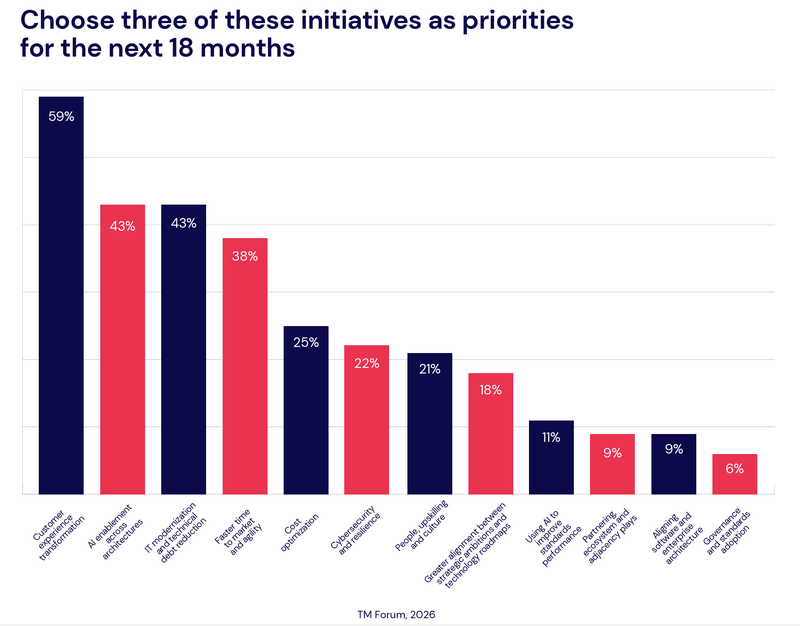
For TELUS using AI to deliver efficiencies while improving customer experience is currently a focus for its enterprise arm. “Internally in the B-to-B side, we are working with the Telus digital team around our own AI and agentic implementations that are going to really help with an improved customer experience, as well as margin expansion.”