Login
Register

During Ericsson’s OSS/BSS Summit telcos spelled out the need to simplify their operating environments to manage increasingly complex systems. And why good data and context is foundational for AI and autonomous networks .
 Joanne Taaffe
Swisscom and Vodafone spell out business gains from OSS and data transformation
This week it was the turn of technology leaders from Swisscom and Vodafone, speaking at Ericsson’s OSS/BSS Summit, to caution that telcos have to do the hard work of laying OSS and data foundations if they are to achieve network autonomy at scale.
“If we do not pay attention to our underlying foundations, we will build some cool stuff… [But] We will not build an autonomous network system working across multiple domains, delivering the business value,” said Simon Norton, Director of Digital Networks, AI & OSS, Vodafone.
Norton described OSS simplification as the “number one foundation.” Vodafone started simplifying its OSS at scale four years ago. To date, it has removed 450 tools across its European network, which “delivered nine-figure cumulative savings over that period,” said Norton, adding that “this is money that we're reinvesting in the future.” The alternative, he argued, is costly technological stagnation.
“If we don't create headroom [through simplifying our asset base], very simply, we will tie down an ever-greater proportion of our budgets standing still,” said Norton.
Given the scale of the Vodafone Group’s network, “we only need to deliver small percentage changes to things like unit cost or time to market for these autonomous cases to really start washing their own faces,” claimed Norton.
Simplification also accelerates the pace at which Vodafone can innovate, which in turn speeds up the investment cycle. “I'm no longer having to plug in four or five performance management systems. I've got one data mesh that sits behind it, and I can start adding value immediately, avoiding all of that architectural toil … of getting things ready.”
Failing fast and cheaply
Network simplification is also allowing Swisscom to “innovate fast and cheap,” according to Mark Düsener, Head of IT, Network & Infrastructure, Swisscom, and creating “headroom ... to think differently for the future.”
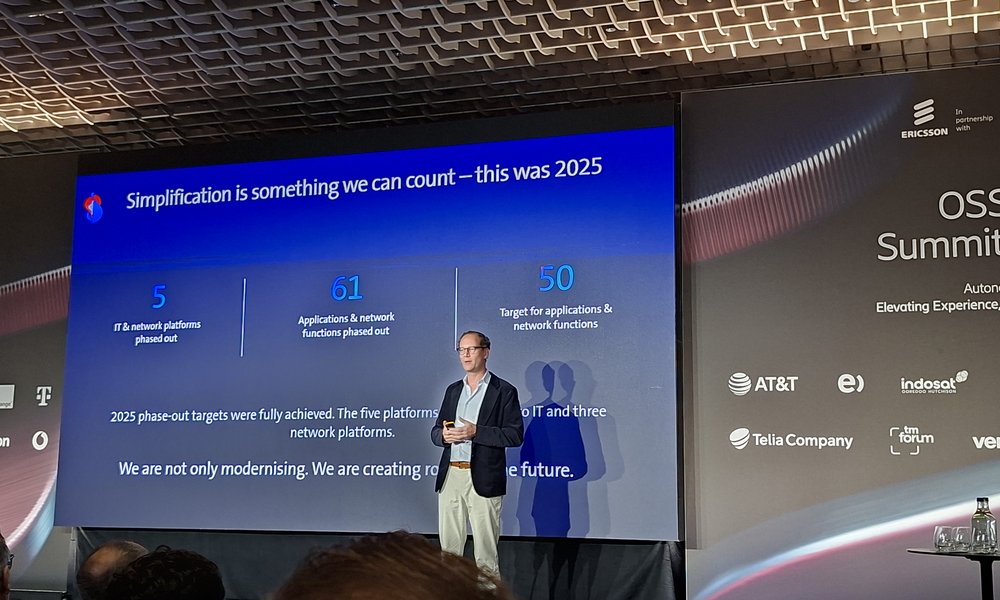
Six years ago, Swisscom had 15 IP networks. “We had enormous platforms, enormous applications that were outdated. We started to clean up all of them. Without that, you die in complexity,” advised Düsener. “Our goal was to have 50 applications and network functions phased out. We achieved 61 and five platforms.”
Today, “if we need an IP network change ... it's an API call, and that is changing quality. That is changing pace and autonomy.” The company now expects to move to a single IP network by March 2027, when it will start a new phase of network simplification. “The virtualized core is on that to-do list already,” added Düsener.
Swisscom redesigned its network IT estate using TM Forum’s Open Digital Architecture (ODA). It broke up tightly coupled legacy OSS systems into 30 disaggregated autonomous operational domains, known as ODMs, which include IP transport, GPON/wireline access and optical transport.
“This is a change that I'm 100% convinced will unlock innovation that we haven't been able to do in the past,” explained Düsener, “because … you can just do a change without impacting,” the rest.
However, Düsener explained that network IT is only half of the story. “We want to unlock innovation and create autonomy across the board.” So even though the company’s BSS is performing well, Swisscom is redesigning it .. so that when it comes to technology innovation, the company is able to “fail fast and cheap.”
Data evolution
But Düsener said the most important project this year has been the development of Swisscom’s One Data platform.
We “will have every data that is consumed in process IT, BSS, OSS, on one data platform, transformed into the Swisscom data model,” said Düsener. “Everything we get from the great tools of our suppliers streamed, will be on that data platform, and you can do correlation. We will have a mesh just based on data.”
This will help Swisscom unlock autonomy, supported by AI agents at scale, he explained. “If you don't have data and you don't have context … they're blind and they will hallucinate by default.
Vodafone is also transforming how it uses data, helped by OSS simplification. As Norton stated, the telecoms industry has evolved from three or four years ago when the trend was to feed lots of raw data into a huge monolithic data lake on a public cloud.
Today, Vodafone is building and cataloguing data products, which can be exposed to BSS teams. “Crucially, it's got the right data contracts and clear ownership,” he explained.
“Getting that underlying data right, catalogued data products … and contracts is fundamental to us,” said Norton. “Autonomy does not require perfect data; it requires known quality … and controls proportionate to the decision.”
Norton also acknowledged more remains to be done: “We need to get that knowledge, which is sitting in people's heads … curated as skills and knowledge artifacts on our organizational semantic knowledge graphs. We need to make sure that we've got governance domain data,” said Norton.
Indeed, several speakers at the Ericsson event underscored the importance of capturing the knowledge that autonomous decision-making will require, including Telstra, which is working closely with Ericsson.
“Something we sometimes forget,” cautioned Düsener that when “we rush into AI if you don't do the data and context right, we will miss the opportunity and take a big risk.”